The Citizenship Test – Who Knows America Best?
Who’s the most American of the people you work with? Test them all with questions immigrants are asked to become citizens. You can crown Most Patriotic of all you work with.

Who’s the most American of the people you work with? Test them all with questions immigrants are asked to become citizens. You can crown Most Patriotic of all you work with.
 I have great respect for shows that take what could be standard, pro forma content, and twist it even slightly to make it more effective. Summer is upon us and that brings back memories for many of summer flings. Did you have one in your life? You didn’t have to in order to relate to this topic. Elizabeth and Radar, 99.1 The MIX, Milwaukee know the power of both nostalgia and storytelling. They took calls from listeners who told them a story about a summer romance they once had. At the end, they had to guess if the romance was a fling or forever. What’s best is that twist – in the frame of the topic, listeners followed along and guessed in their minds, too. Creating content that listeners had to pay attention to because of how it was designed.
We’re in the audio and video business now. Which is why Karen Carson in the Morning, with Johnny Minge and Intern Anthony, WNEW-FM, New York have added a new feature to their show they do on occasion called That Thing on Your Ring. Listeners call to talk about the odd thing their Ring doorbell camera picked up in the yard. Great stories with proper call screening – always fun and interesting to hear. But this feature has evolved! Because we must also have video for social media, the team now gets callers to send them the videos, which are stamped with the show and station logos and used on their social media feeds to entertain fans there with great content, too.
With the FIFA World Cup the biggest story in America for the next few weeks, choose a premiere match up every few days and learn how to say simple things in those languages on the show by inviting in someone fluent who can teach them to you.
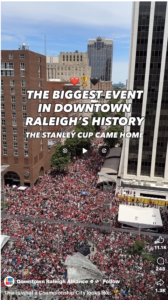 The Carolina Hurricanes won the Stanley Cup and there’s a vibe shift in my hometown of Raleigh, NC we should never lose. People are smiling at strangers. Car horns aren’t expressing frustration, they’re celebrating. Social media isn’t filled with arguments.
People are weeping with happiness, and radio needs to create that local pride every day.
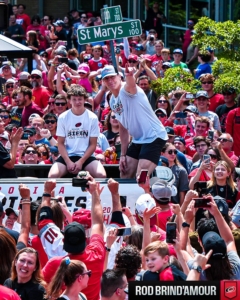
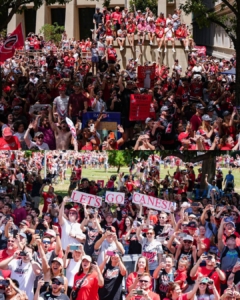
People who have nothing else in common are connected by a shared feeling. The Carolina Hurricanes were celebrated with a parade 150,000 people attended. They didn’t just win the Cup. They reminded an entire community what it feels like to be part of something bigger than themselves. Everyone has new best friends.
My message in this week’s Planet Reynolds is that radio has the power to do that every day.
Often, we see ourselves in the entertainment business. And most days we are. But we’re also in the belief business. Think of that big service project you did to support a cause important to you. You had to move fans into the belief business to get that done.
Every day, we decide what matters. We help listeners choose what to care about. We help shape how they feel about where they live. If we spend hours every day talking about what’s broken, we’re teaching the audience what to believe about the community.
But if we spend hours every day celebrating local people, local victories, local traditions, and local pride, we’re teaching them something else. We’re teaching them that this is a place worth loving.
I live in a market with Duke, UNC-Chapel Hill, and NC State. We have seen championships before. But this one was different. It bonded the community like nothing I’ve seen in my decades here.
Often these feelings of joy live for a short while. A team wins, you celebrate, then a few days later it dissipates. I wonder what it would be like for all of us to make a longer-term commitment to celebrating where we live.
The negativity industry is thriving. Algorithms reward outrage. Cable news loves division. Social media radiates conflict. Everywhere we go, someone or something is telling us what should make us angry.
Radio has an opportunity to do something different, because you control how listeners feel by what you do. There might be problems, but there are also victories. Yes, there’s conflict, but there’s also kindness. There certainly is division, but there’s also community.
Sometimes the most rebellious thing a personality can do is make people feel hopeful. It’s like running in the opposite direction from everything else we experience.
No one can tell the story of your town better than you. Nobody can celebrate local heroes better than you. Nobody can create pride in your community better than you. This is not about putting on your show a Thursday feature called Hometown Heroes and ticking that box. It’s about making a wholesale change in your content to always be the champions of your city. A vibe that permeates everything.
When the Hurricanes won, the great radio stations of Raleigh didn’t just report it. They amplified what it meant to be a community experience. When they won 20 years ago, the celebration was them parading in the parking lot of the arena where they played (true!). When the Hartford Whalers moved here 30 years ago, they said hockey wouldn’t work in the south. This time, 150,000 showed up to the streets of downtown Raleigh to express their love for what the team did for us. And the team responded in kind.
The best personalities become the emotional mayors of their communities. They celebrate what deserves celebrating. They shine a bright spotlight on those who make a difference. They create moments where listeners feel connected to one another. They don’t tune in just for a laugh, but because they’re desperately in search of something that makes them feel good about where they live. You can help them see their hometown through a better lens.
Do you need a winning team like we have in Raleigh or in New York when the Knicks won? Nope, you just need to access the passion you have for your town, then make that content commitment to your fans.
 If we committed to making daily moments of civic pride, what might that be like? One story, one local hero, one example of generosity, one reason to feel grateful. Imagine the cumulative effect if you did that five days a week, 52 weeks a year. Not just to build ratings and revenue. But to build belief. Because when people feel connected to their community, they become happier citizens, better neighbors, and more engaged participants in local life. And if you did that, how might you be celebrated?
Build that community and radio becomes more than a source for content. It becomes an epicenter for connection.
The roar coming from Raleigh wasn’t really about hockey. It was about identity, it was about belonging, and it was about thousands of people sharing the same feeling at the same time. That’s why we wept.
Radio has always possessed that same superpower. The question isn’t whether we can create those moments. The question is whether we’ll become intentional enough to use them.
Because in a world that’s constantly telling people what’s wrong, great talent can still remind them what’s right. And that might be the most important job we have.
You game?
Relevance is when you’re on a topic of the moment. Something happening now is high school graduations. Marry that topic with an idea that would resonate with your demo, and it’s gold. Anna and Raven, Star 99.9, Bridgeport, CT (syndicated) know their Hot AC audience is adult women, many of whom have high school students graduating this month. Some of those graduates will go on to college, which can be quite expensive. Which is why they did Scratch It for Your Graduate. A listener came on to gush about their kid then talk about the university they were going to in the fall. They had a bunch of lottery tickets in the studio! They scratched a card and gave the caller whatever the winnings were to defray the cost of board and tuition for freshman year. Clever and relevant.
Father’s Day is June 21. Gather dad jokes from listeners this week – set up a phone line where they can leave their name, city, and dad joke. Then, on your show this Friday, feature a listener with a dad joke every ten minutes. If you wanna cover 6:00-9:00am, you’ll need eighteen (with no recycling). Make it a theme this week to get them for a relevant Friday show.
Several years ago, I was invited to attend a gathering of Hubbard programmers. Traditionally when programmers of any company gather, it’s time to learn. One of the teachers that day, besides me, was Fred Jacobs.
Fred gives a great presentation and something he said that day has stayed with me for years: Donald Trump would have been an amazingly successful program director because he knows how to command our attention and create talk.
 The previous Planet Reynolds (Steve Wants to Sell You a Horse) noted how we are in the Attention Economy now. Everywhere we turn, something is vying to capture our attention. I’d mentioned in that piece that often what I hear on radio shows is pleasant people having pleasant conversations about perfectly acceptable topics. We don’t try hard enough to capture and keep the attention of our listeners. By not doing that, we create the circumstances where something else will. That’s one of the reasons TSL is abysmal.
So, Steve got to thinking! I noodled on this question: what does Donald Trump do that makes all of us, regardless of whether we love or hate him, stop to pay attention? And what can we take from that to get better so our fans don’t leave?
Here are the ten items I landed on with applications of how they might work for you. I’m not advocating you start talking about politics or culture-war issues. But seizing on some of his techniques noted here up against the topics appropriate for your show might create more energy where listeners will stay longer or come back because you’re electric. Because tension equals attention.
Attention beats perfection. A show that occasionally ruffles feathers, but sparks conversation will beat a polite show no one talks about.
The world around us has changed, folks. It’s louder, edgier, and very, very noisy. Job #1 is to capture their attention. Job #2 is to keep it.
Do that and they won’t just hear you, they’ll follow you.
With ten weeks to go before Labor Day (the traditional end of the summer), how about re-kindling romance with Ten Dates in Ten Weeks. Profile a different cool date locals could enjoy in your market. This one is sponsorable so, share the idea with the sales folks so they can win, too.
It’s politics without doing politics. I’m long enamored by the creative brain that hears one thing, and thinks of another. Such was the case with Zog and Ivy Unleashed, Power 96, Miami. Local politician and Secretary of State Marco Rubio (he’s from Miami) sometimes uses contemporary phrases when talking geopolitical topics. Zog’s brain lives in technicolor. So, he married Rubio’s audio to the appropriate song in their format (throwbacks), as you’ll hear in this week’s audio. This scores on multiple levels: it’s topical, it’s local, it’s music-oriented, it’s funny, and the break is short. You wouldn’t think it’d get green check marks in so many areas, but once you listen you’ll hear it yourself.