
Friction Hooks Fans – A Better Way to Build Character Connections (Heated Rivalry Edition)
You’ll come for the sex; you’ll stay for the story.
Heated Rivalry is the “it” show now – lots of buzz. It’s on everyone’s timeline and seemingly inescapable in conversation. Why is it resonating and what’s to learn from that?
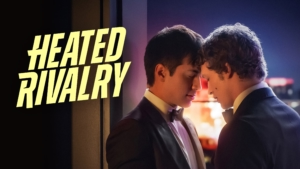 Heated Rivalry does the one thing at its core every show must do to shift people from being listeners to becoming fans: they make us care about the characters. Think of any show or movie that moved you – that connected with you that you still rave about – and note that the screenwriter and story made you care about the people in it. Think of who you hang with in your personal life; those you know and those you care about. You must do the same with your show to create that loyalty with listeners.
Heated Rivalry works because conflict is the engine. The characters are rich and deep and human and flawed and very different from each other. That contrast creates a powerful storyline.
Here’s proof that conflict is the oxygen of storytelling. Heated Rivalry doesn’t succeed because everything goes right. It succeeds because almost nothing does. The story draws us in because there’s lots of drama. If your story is boring, it’s because drama doesn’t exist.
At its core, Heated Rivalry is built on opposition. Two very different elite competitors locked in a long-term clash where winning isn’t just about the scoreboard. It’s about pride, identity, ego, and the quiet fear of being seen as less than the other. That tension never fully resolves, and that’s the point. Resolution ends the story. Friction keeps it breathing.
The show’s most effective tension point is the collision between public personas and private truth. On the surface, these characters are confident, dominant, and unyielding. Underneath, they’re insecure, guarded, and hungry for validation and connection. One is Russian, the other Canadian – and the stereotypes that come with each. Every scene’s bravado cracks just a little which pulls us closer to the characters and storyline. We recognize that feeling because we live there, too.
Another smart pressure point is proximity without permission. The characters are forced together by circumstance. Same arenas. Same headlines. Same orbit. They don’t choose connection; it keeps choosing them. That creates emotional whiplash: attraction colliding with resentment, admiration tangled with jealousy. Viewers aren’t watching to see if something will happen, but how long they can resist it and what it will cost them when they stop.
Sometimes the tension is big – Shane’s been texting Ilya for six months and been ghosted. The anger and hurt feelings are both relatable and palatable. And sometimes it’s small – Shane introduces himself to Ilya at the top of episode one. They’re two premiere athletes and one of them is secretly smoking cigarettes.
Emotionally, the show plays a rich chord progression. Competition lights the spark, anger sharpens it, vulnerability deepens it, and fear threatens to extinguish it.
We care because the stakes are high – we root for Ilya and Shane because we want people to root for us. That’s why vulnerability is so powerful in life and radio – we want the audience to care and root for us, too – and they want to know that we care for and root for them. You must do that with your content to win. Because if your content is friction free – if it has no drama – you ain’t got nothing.
Heated Rivalry understands something many shows miss: likability is optional, but emotional honesty is not. The characters are often difficult. They make selfish choices. They hurt each other. Yet the show earns our loyalty by letting us see why. We’re not asked to excuse their behavior, only to understand it.
Conflict creates curiosity. Tension creates attachment. Emotion creates memory.
That’s the lesson Heated Rivalry teaches. Storylines don’t become compelling by smoothing edges. They become compelling by pressing on them and refusing to let go.
And that’s what keeps us watching.
The success of Heated Rivalry should teach us lessons. What should be our takeaways if we believe in the power of radio talent to make a difference?
Radio talent often believe the goal is to be agreeable, upbeat, and without friction – liked by all. But the show proves the opposite. Audiences don’t bond with perfection. They bond with flaws and pressure.
Lesson One: Find the Tension in Everything and Let It Breathe
In Heated Rivalry, the characters don’t rush to tidy conclusions. They sit in discomfort. They argue. They hesitate. They contradict themselves. That’s what makes them human.
For radio, this means that the messy wins. Try to position yourself as perfect or unflawed and you’ll lose. My friend Lori Lewis says, “unpolished is the new polished.” She’s right. If you’re wrestling with a decision, a frustration, or a change, let the audience hear the wrestle. Unfinished emotions create forward motion. Forward motion keeps people listening. No tension/conflict/drama/friction = no memorable story.
Lesson Two: Stakes Make Stories Sticky
Every conflict in the show costs something. Reputation. Identity. Trust. That’s why it matters.
On the air, stories without stakes sound like anecdotes. Stories with stakes sound like life. When you tell a story, ask yourself: What did I risk? What could I lose? What changed because of this? If nothing was on the line, the audience won’t lean in.
Lesson Three: Vulnerability Beats Likability
The leads in Heated Rivalry aren’t always likable, but they are emotionally honest. That’s the trade.
Radio personalities often chase approval when they should chase truth. Saying “I didn’t handle that well” or “I’m not proud of this reaction” or “I don’t understand that” builds more trust than trying to sound polished. Vulnerability is the shortcut to credibility.
Lesson Four: Conflict Doesn’t Mean Chaos or Arguing
The show’s tension is controlled. Purposeful. Directed.
On the air, conflict doesn’t mean yelling or controversy for its own sake. It means contrast. Opinions that collide. Expectations that aren’t met. Internal debates spoken out loud. That kind of friction creates texture without alienation.
Heated Rivalry reminds us that connection isn’t built by being smooth. It’s built by being real under pressure.
If you want listeners to care about you, let them hear what you care about enough to struggle with. That’s where the bond forms.
Ilya, Shane, Scott, and Kip’s characters are grounded in tenderness, struggle, and betrayal and you want what’s best for them, because you want what’s best for you. So does the audience. So connect there.
By all means enjoy the steamy sex in the first few episodes of Heated Rivlary. That’s the show’s hook. But at the end of episode six, know that you stayed for much different reasons. Then see what you learn from that to deepen and grow the bond you have with your fans by how you do your content.