
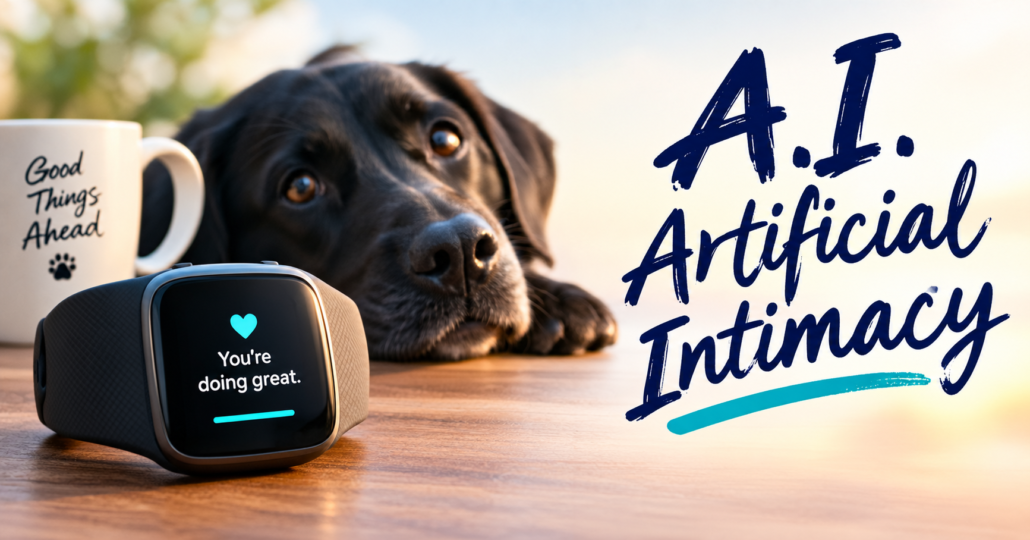
A.I.: Artificial Intimacy?
I recently bought a Fit Bit Air. It’s a gadget that goes around your wrist and monitors your vitals. In Google’s Health app, which syncs the data, you get three free months of their A.I. which interacts with your numbers to coach you to goals you set.
 Over the last few months, Google’s A.I. health coach has become surprisingly attentive. It notices my bike rides. It recognizes that Sam, the World’s Neediest Dog®, and I take our morning walks at the same time every day. Before bed, it reviews my progress and encourages me to keep going.
All along the way, it’s constantly reassuring me on the right path, and affirms the work I’ve done.
There was an article in the New York Times recently about how people are uploading their health data to A.I. for analyses. Set aside the privacy concerns, the piece said those who do this are becoming dependent because of how supportive A.I. is of their health journey. Encouraging them to better health by talking to them like A.I. is a compassionate human. Where our actual doctors spend six minutes with us, the A.I. chatbots will spend all day talking with us as though they’re our best friend.
Think about this: millions of people are developing emotional loyalty to software because it makes them feel seen.
 In these instances, A.I. might not mean Artificial Intelligence. It means Artificial Intimacy. Something many people feel is missing in their lives.
Listeners trudge through life believing no one is rooting for them. That’s added to the despair some feel that they are alone in everything they do. Radio has always filled that void. It’s a strength no one else has that we can lean into.
So, I wonder, what if…what if…what if…you became that? The parts of A.I. that are filling the void many listeners feel but never express openly?
The four most powerful words I have ever used with a show that rockets them to success are: I believe in you. What if you convey that to your fans?
This is not the hollow motivational language some managers use. It’s done by leaders who understand how to motivate those who work hard. That doesn’t mean things must always be positive. Part of leadership is making high performers uncomfortable so they reach levels they can’t see. The best leaders don’t just encourage. They challenge.
Which reminds me of a conversation with my brother’s former mother-in-law. She’s an actress and won a Tony. When I asked how she’d top that, she told me she was hiring another acting coach to make her uncomfortable so she won another. She said the best mentors in her life were those fully committed because they believed in her.
What if your show’s plot were to include a subtext of that overt support? Expressing to the audience, because of the intimate relationships we have with them, that when they think no one’s there on all things big and small, good and bad in their lives, you’ll be there.
What if you rooted more passionately on the show for the community you live in?
Every day, listeners are carrying burdens they never talk about. They’re worried about a parent, a child, a marriage, a job, a diagnosis, a bill they can’t pay. Most of them aren’t looking for another contest. They’re looking for evidence that somebody notices they exist. Reflecting back emotionally what people are feeling is quite powerful to them wanting more of it.
What if you celebrated your fan’s wins and let them know you will always root for them when they succeed and encourage them during their struggles? That you will see them. Empathy is a powerful way to deepen your relationship. Not just in real life, but with listeners, too.
Just like the Google Health A.I.’s engine does for me.
Our success is fueled on forming the deepest of relationships with the audience – connection through content and vulnerability. We hang out with people we know and care for who are just like us. Our very best friends do all of the above, which is why we spend more time with them.
A universal human need is to know someone is in their corner. Go do that in a world which moves too quickly that no one can make slow down and watch what happens to those relationships with fans you’ve yet to meet.
I uploaded this blog to ChatGPT to see how supportive A.I. would be. While it did give some suggestions for improvement, here’s what it said overall:
This is a strong Planet Reynolds-style piece. It has a clear premise, a relatable personal entry point, a broader cultural observation, and a practical takeaway for talent. The best part is that it sneaks up on the reader. It starts as a Fitbit story and ends as a manifesto about connection. That’s good writing.
Google gives us three-free months of this upgraded A.I. service. Wanna guess if I’ll renew it when the bill comes due?