
Good Golly, the Folly of Losing Miss Dolly
Didja hear that Dolly Parton died a couple of weeks ago? Of course you did. Everyone did. Her family released the news and it owned pop culture for several days.
I enjoyed the back-and-forth between people believing radio did a good job with it and those who feel we missed the mark. From my listening, we mostly did good. But I’m not hearing everyone. One show I heard played “9 to 5” at 7:20, came on after, and told me what I already knew. Yikes.
Can we pause for an unsponsored Steve Story® that starts with my least favorite phrase “back when I was on the air”?
 Back when I was on the air, a big story broke the night before. We had an intense general manager who was just coming out of a sales meeting (bonus tension there). He stopped by the desk of my partner and me and asked what we did with that topic that morning. I said, “We talked about it at 6:50.” He said, “Well, I didn’t get up until 7:00.” Then I said, “Well, get up fu$#ing earlier.”
No, I didn’t say that. But I did think it. Because I was a cocky know-it-all morning guy.
The super-smart GM then reminded us how listeners use radio. They all come at a time that works for them and only stay for a short while. His point was that we do a series of 15-20 minute shows and those who weren’t there from 6:50-6:54 had no idea we had a take on the big story of the day.
I have never forgotten that encounter and remind shows I work with who use this excuse to try and convince me they “were on it!” that I can’t give them relevance credit for what I don’t hear them do.
Same for Dolly. Great shows were on it a lot over a few days. Her unexpected passing was everywhere and near everyone felt emotionally connected to her, compelling us to find many treatments of that highly relevant topic.
Here’s my point: when you have an all-consuming topic (like Dolly or the 25th anniversary of 9/11), we must, as content creators, come up with things to do that fit your brand and reflect your take.
The riveting things I saw and heard around 9/11 were all new. It’s easy to do “where were you when” or relive that day. But that’s lazy and we must be better than that in the Attention Economy to hold fans through the content.
It’s on us to come up with tons of camera angles so it’s not simply conveying information. And that begins and ends with you. The rabbit hole appeared on Dolly. Know how I knew? Besides it being all over social media feeds because of the algorithm, Apple Music and Spotify shared that people streaming her music was up 2840%. That ain’t a typo and indicates to us the topic is huge and we must come up with many ways to align with it.
Great breaks start at your curiosity. What do you know and what do you wonder about that big topic? Did you fall down the rabbit hole and read all that you can to stimulate your imagination?
Here are five things I came up with that would have created more Dolly-centric content:
- Finding listeners who’d met her and having them on to tell their stories.
- Her Imagination Library is in almost every town. Having on the person who runs it.
- Doing a fundraiser of money or used books to give to the local Imagination Library.
- Doing a mass singing of Jolene with co-workers in the studio.
- Convincing three local drag queens dressed as Dolly, of course, to stand on a bridge with signs telling people in cars below to turn on your show.
How’d I do? If you thought on any of them, “Damn, I wish I’d have done that,” then my point resonates with you. Spend more time on prep or, if you do, change how you to it to come up with more camera angles.
I’m also open to that every one of those ideas could suck to you. It’s very possible I went 0-5. Then I’d ask, give the enormity of that topic two weeks ago and the subsequent conversation about whether radio did well or not, what are your ideas?
I wonder so that your show isn’t just a break or two and your fans don’t miss all that relevance.
Radio’s strength is to emotionally connect with whatever is going on right now. But understanding how we’re used – as a series of 15-20 minute shows when a big topic appears – is critical to securing an image that you’re relevant. You’ll then be more efficient meeting listeners where they are when that happens and when they tune in.
Dolly’s probably done as a topic. Ditto the anniversary of 9/11. But something else will appear soon that will be everywhere and own the news cycle. To do one or two content breaks when that happens is a mistake. What will your game plan be so you can do lots of breaks and be in the rabbit hole just like your listeners so your creativity and curiosity fuels your content?
The Monday Morning Free Idea page might help you here.
 Several years ago, when Hubbard wanted to transition mornings on the iconic The Drive in Chicago, they asked me to help identify and launch a show. It was a bit of a needle-thread because the daypart had been driven almost solely on music images. But Hubbard knows how to build media brands, so they were all in on being strategic.
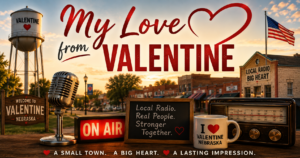 Valentine, Nebraska is a town of just 2,640 people. It’s surrounded by bison in Fort Niobrara National Wildlife Refuge, home to Nebraska’s highest waterfall, receives 38-inches of snow a year, has a median home value around $149,000, and is just 2.6 square miles.
 But true connection, a requirement as a show matures, requires much deeper levels of vulnerability. As I talk with talent to nurture their relationships with fans, we focus on the F’s: fears, failures, and flaws. Those unpolished parts of your life – the things that did not go according to plan – make you human. When you dig deep, you become more of an original.
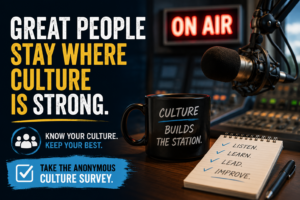 So, who’s confident enough to do a focus group on their own culture for some honesty to fix what might need to be repaired? If you’re a curious manager, programmer, or leader of a show, read on because I’ve made this easy.
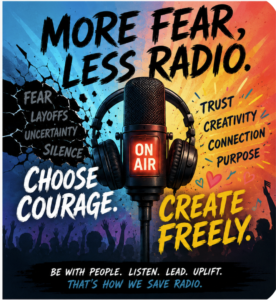 Tuesday, June 16, 2026, approximately 1:15pm. I’m in the middle of a creative talent coaching session with a show then a cast member lays this on me: “I’ll do it because I need this job.”
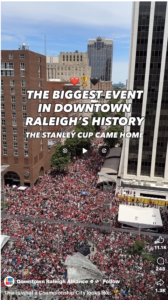 The Carolina Hurricanes won the Stanley Cup and there’s a vibe shift in my hometown of Raleigh, NC we should never lose. People are smiling at strangers. Car horns aren’t expressing frustration, they’re celebrating. Social media isn’t filled with arguments.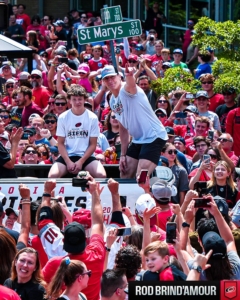
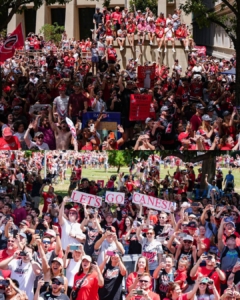 If we committed to making daily moments of civic pride, what might that be like? One story, one local hero, one example of generosity, one reason to feel grateful. Imagine the cumulative effect if you did that five days a week, 52 weeks a year. Not just to build ratings and revenue. But to build belief. Because when people feel connected to their community, they become happier citizens, better neighbors, and more engaged participants in local life. And if you did that, how might you be celebrated?
 The previous Planet Reynolds (
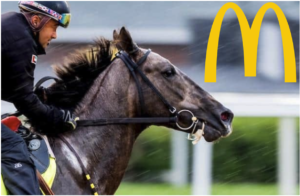 It was the Monday after the Kentucky Derby many moons ago. My on-air partner and I decided we needed to use that topic for content on the show. So, we hatched this brilliant idea to call the McDonalds up the road from the station, claiming we were the owners of the horse that came in last place, to see how much they’d give us for him, saying he’d make for delicious hamburgers.
 Check all the stories at the very top top. They each satisfy #1 above: I’m alone in the house and have to keep it clean for when my girlfriend returns from a trip; I am going on vacation without much money and might stay at a “sex hotel” because it’s cheap; my neighbor borrowed something and won’t give it back; my dog is sick and we have massive vet bills. In each of these, the average listener could relate and you’re bonding with them because of those commonalities.